It’s safe to say that not everyone is a fan of mixed doubles, but when executed correctly it can be just as entertaining as either of the other two disciplines. Look no further than today’s Hopman Cup deciding rubber which saw prolific Serbs Novak Djokovic and Ana Ivanovic scrape past Aussie youngsters Bernard Tomic and Ashleigh Barty in an epic 3 (more like 2 and a quarter) set match.
For better or worse, crazy things happen when the ATP and WTA collide. But even so, I can’t think of too many more surreal sights in any sport than watching the 5-time Grand Slam winning current ATP world number one and greatest returner on the planet gravely struggling to read and return the serve of a 5ft4, 16 year old girl ranked 175 on the women’s tour. Oh, and there’s also the small matter of the above jaw-droppingly outrageous 29-stroke stroke rally between the four on Serbia’s first match point. (Mixed) Doubles? Love it.
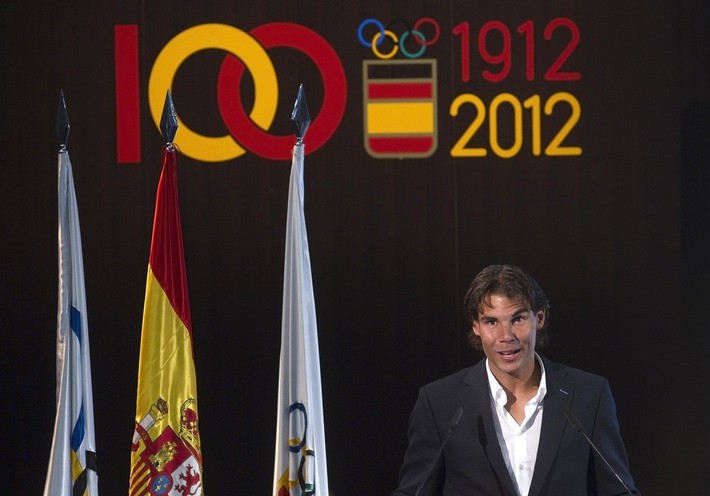
So, let’s have some facts, eh? Today, Rafael Nadal dropped a nuclear bombshell on the Olympics build-up as he announcing his withdrawal from the event. His infamous chronic knees are to blame. The signs were there – not only have rumors and talk about his knee injury been swirling around long before Wimbledon even concluded, but it has always been fairly evident that aside from his knees, Nadal’s biggest enemy has been the ticking clock as the Olympics draw ever closer. But even so, considering just a couple of days ago Benito he was posting pictures of himself doing rehab in the gym with an insanely gleeful smile plastered on his face, the alarm and shock at this turn of events is more than warranted.
Discussions on whether or not Tennis deserves its place in the Olympics have raged on for years now, but regardless of whether tennis as a sport is suited to the competition, there’s no doubt that Nadal himself is. He stands as one of the players (also look towards Venus Williams) who genuinely cherishes and truly understands the significance and honour of being an Olympian. For him, the Olympics is clearly more than the pursuit of nice, shiny medals. He gets it, and in a sport like tennis, not every player does. He called the withdrawal one of the toughest decisions he has ever made and one of the worst days of his tennis career, and it’s not difficult to see why.
But aside from disappointment and sympathy towards Nadal, I’m struggling to understand the point of speculating about much else. People are already collapsing into hysterical wrecks and proclaiming Nadal’s career over, or else pointedly suggesting that the knees must *clearly* be in awful condition for him to withdraw. Perhaps the doomsaying and worrying has some merit, but one thing we do know is that we saw this all before in 2009 and a year later he went on to have the best year of his career. He isn’t the first player to suffer from tendinitis and he won’t be the last. It’s certainly not easy, but it’s something he has managed and will continue to do so.
And finally there’s the case of Mr Federer and people subsequently expecting him to waltz to his first singles Olympic Gold. Despite Nadal standing as the sole (ahem) relevant active player to defeat Federer on grass, the Spaniard’s fairly appalling 21-11 record in three-setters off grass over the past year pull him straight back down to earth. Massive opposition remains in the form of Djokovic and Murray, the Brit holding an exemplary 8-5 record over three sets against Federer over three and Djokovic who will undoubtedly be hungry for revenge after Federer wrote a new chapter into ther rivalry at Wimbledon. I would even venture to suggest that Nadal’s withdrawal is far from being a pivotal or draw-altering.
But while I close my eyes, place fingers in my ears and hum away the blind speculation, others are… not. Namely Uncle Toni who stated that London was the last Nadal’s Olympic opportunity, implying that he will be retired within four years. Not only is writing Nadal off for the next Olympic games as premature as Novak Djokovic when retreating into the shade on a hot day, it’s just, well – to quote Federer – I mean, puh-lease. Are you kidding me?
Jennifer Capriati. What is there to say that hasn’t already been said about this woman? She stands as one of the greatest, most talented and divisive players in a generation bursting at the seams with greatness, talent and controversy. In her wildly scattered 14 years on tour, the American amassed a total of three Grand Slam titles, an Olympic Gold Singles medal, 17 weeks at number one and countless classic victories (and losses) against the greatest players over two separate generations.
It’s tough, however, to pinpoint her single her most memorable moment. Was it her supernova rise up the rankings while barely a teenager? She made her tour debut on the WTA tour in 1990 aged 13 and immediately stormed to the final of two of the first three events before reaching the semis of her first Grand Slam in Paris. A year later she broke into the top ten, and in the following year dispatched of Sanchez-Vicario and Graf – the top two players in the world – to take the Olympic Gold in Barcelona aged 16. Not too shabby.
Of course, there’s also that small issue of the “c” word. We’ve all heard about her famed comeback – the burnout, the shoplifting arrest, the marijuana possession, that mug shot, her resulting lengthy break and the desperate struggle (and initial failure) to regain anything resembling previous form, the reporters who smugly wrote her off. She could have easily allowed herself to swept away into the tsunami-sized wave of burnt out young prodigies. But she didn’t. She persevered, slowly building her way back to the top. After completely falling out of the rankings in 1994 and failing in her initial comeback a year later, she picked up her first Grand Slam win in 5 years at the 1998 Wimbledon. A lowly title and #23 finish followed a year later. A slam semifinal and top 15 finish in 2000. And finally, the fairy tale was completed in 2001 as she eased past second-ranked Davenport and top-ranked Hingis in succession to capture her first slam title in Australia. But you already new that all.
Two of Capriati’s single most memorable moments were her famed epic slam finals. The first at Roland Garros in 2001 when a young Aussie Kim burst into relevance by reaching her first slam final. Despite the young Belgian matching both Capriati’s supreme athleticism and power with ease, there was no panicking to be seen from the reigning Australian Open champion as she was swiftly delivered a shock first set breadstick. Instead, she embraced the challenge, putting her head down and finding her range to level up the match. By the third, both women were in full-slugfest mode with their lightning-fast movement, intricate footwork and spectacular shotmaking simultaneously cancelling each other out and enhancing the other. The third set wore on well into overtime, with Capriati twice serving for the title while a resilient Clijsters pegged the American back each time. But eventually the champion‘s extra grit and mental strength proved the difference between the two and she edged out the title..
Capriati’s third and final slam title would come in Australia the very next year in conditions so difficult that the heat practically radiated through the television set and left Capriati even pissier and more vexated than her, well, usual pissy and vexated self. Hingis raced up a set and break, looking ripe for her sixth slam title. In response, Capriati dug deeper than ever before, first hunting back the break before fighting off multiple match points. Her effort was painfully visible as she collapsed into the linesman chairs between most points, but she refused to succumb, saving yet another match point and spectacularly surviving the second set tiebreak. Before long, the script was flipped on its head as Hingis ditched her trademark overly self-confident and carefree demeanour and retreated back into the shade, panting, exhausted and defeated. The 2002 Australian Open may have proved to be Capriati’s last great victory, but she saved the best til last.
None of this answers the original question, however. Probably because she herself is far more interesting than the titles she collected. She’ll always be remembered as the complex figure she cut – the tennis player whose game was not defined simply by defence or offence, the person who paradoxically stood as the ultimate role model in the art of never giving up, yet was notorious for her vulgar attitude and behaviour. In other words, Jen-Cap will be remembered as Jen-Cap.
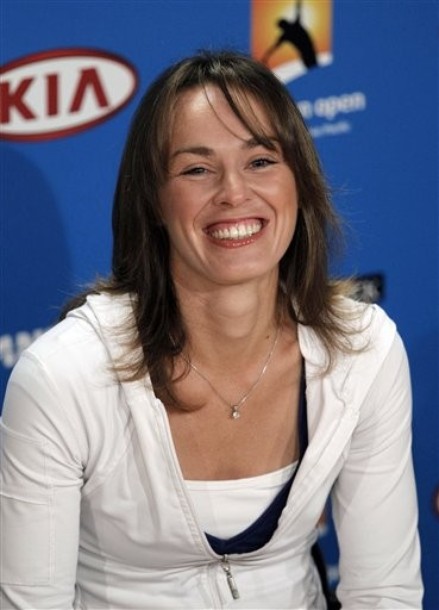
Though often a critic of many of the WTA players on tour, when asked about the supposed lack of depth on the WTA during yesterday’s press conference, Martina Hingis’ reaction to the suggestion that there is no depth on the WTA in 2012 was very telling.
Are you serious? Are you kidding? I mean, now with the great matches we see, Lisicki played already against Kuznetsova. That was a great match. Now she plays Sharapova and it was a great match. I don’t know.
First rounds, come on. How about Djokovic killing everyone in the first three rounds or Federer not losing a set, more than three games in a set.
I mean, it’s just sometimes that’s the way it is. If champions are champions, they’re well‑prepared and they’re going to play well from the beginning.
I hear no lies.
Sharapova was actually asked an identical question last week, and it is hilarious that for most of the last three years, the WTA has seen such a myriad of different players of different ages, gamestyles and nationalities breaking through into the later stages of Grand Slams. And yet the one rare time that the semifinal lineup is filled with only Grand Slam Champions and top 5 players, it automatically means that the sport has no depth.
Though they attend the events and act the part, it’s tough to believe that many of the people who ask such questions truly pay much attention the sport they are paid to write on.
It is probably not often that Roger Federer gets starstruck and nervous from merely being in the presence of a person, but judging by the amount of nervous smiling on show from the GOAT, sitting down in the ESPN studio to chat with Rod Laver was one of those rare moments.
Late in their titanic four-set battle, Tomas Berdych and Nicolas Almagro found themselves in an entertaining exchange which finished with Almagro drilling a ball so hard at his opponent that the seventh-seed ended up in a heap on the ground. The incident was not quickly forgotten by Berdych, and after clinching the match he made his thoughts on Almagro’s body-blow clear by refusing to shake the Spaniard’s hand at the net.
To say the crowd didn’t take kindly to Berdych’s actions would be the understatement of the century.
This whole incident was the epitome of overreacting. Did Almagro need to smash the ball straight at Berdych? Probably not. Should Berdych have shaken Almagro’s hand? Of course. The biggest overreaction, however, came from the clearly intoxicated crowd who put Roland Garros to shame as they booed mercilessly during Berdych’s on-court interview. Even worse still, as he attempted to carry out his Eurosport interview, a man nearby interrupted the interview, repeatedly shouting at Berdych and calling him a “prick”. An appalling overreaction for what was still a relatively minor incident.
After spending the last couple of months appealing to the powers-that-be for a reprieve to the FFT’s ruiling that Bartoli would not be participating in the Olympics, it appears that Marion Bartoli finally all but admitted defeat while addressing the issue after yesterdays victory over Jelena Dokic.
“It’s really heartbreaking for me. Honestly I really do feel I have a chance to make a medal over there and especially at Wimbledon, on grass, where I had so much success in the past, and can’t go there just for some stupid reason [...]”
The “stupid reason” Marion is referring to, is one that requires teammates to train together as a (*gasp*) team during the week of the tie. Rather than training with the team, Bartoli has always requested for the rules to be changed in order to allow her father coach her during Fed Cup weeks.
This issue is also one that has actually been previously visited. Back in 2002, then-Fed Cup Captain Billie Jean King made the decision to exclude Jennifer Capriati – her number one player – after she was caught receiving illegal coaching from her notorious father on the evening before the first match.
Capriati learnt her lesson however, and she didn’t ever attempt to challenge the rules afterwards. On the other hand, four years after facing her first Olympic snub in Beijing, Marion is still complaining and refusing to comply with the rules. If she really wanted to represent her country at the Olympic games, then she only has herself to blame.
It’s easy to hate on Bernard Tomic; He’s young, he’s talented, he carries with him an air of quiet (and sometimes very loud) arrogance, he stupidly drives a car so ridiculously flashy and OTT that the law only permits him to use it to and from practice, and as of today we can see that he also appears to already be reaping the rewards of fame romantically.
We were all given yet another reason to do so yesterday when the confident teenager belittled Fernando Verdasco – his first round performance – during his press run.
“It’s a winnable match for me. It’s not one of those big names, like a big seed [...] He beat me once in Brisbane I think when I was 16 up there. That was when he was on his run, playing well. I think, you know, the last six months he hasn’t really done much. I think it’s a good time to play him.”
As harsh and overconfident his comments appear, Tomic is only regurgitating what most knowledgeable tennis fans have been saying for a long time now. And in an era where players are so willing to play the tired ‘PR game’ in order to stay on the right side of the media, Tomic’s comments are quite refreshing.
Whether or not he can actually back up this talk by upsetting the former Australian Open semifinalist is another question however; one we’ll soon know the answer to and be able to jurge accordingly.
Barely over a week after she already infamously announced her dislike for tennis, Serena Williams took the most unsurprising U-Turn in the history of the world, yesterday proclaiming her “love” for the sport once again;
“I just love the sport so much; I love trophies and I love hanging them up, and I love the competition. This is what I love. This is my job and you get to do something that.. you travel the world, and you don’t get to do that often so it’s pretty cool.”
The hoopla over Serena’s comments in Brisbane were beyond comical. Not only were they not even remotely bad or shocking, but after spending the last thirteen years watching Williams use press conferences as anything from venting/therapy sessions to simply letting her crazy out and having a hoard of people listen to speak absolute gibberish, you would think they would know to take most of what the champion says with a pinch of salt.
Needless to say, I’m sure Serena had quite the chuckle over this whole episode.
Right off the back of the calendar, rankings and Davis Cup drama that we spent so much time on in the fall of 2011, Rafael Nadal has opened up yet a new can of worms by suggesting that the amount of hardcourt events should be cut due to the effects the courts have on tennis players’ bodies;
“The only negative thing about tennis, if I have to say one, is that the competition is too much”
*he says after spending the last three months complaining about every aspect of professional tennis he could possibly complain about*
“The calendar makes the sport too hard; the hardcourts are too aggressive on the body. I really believe that can change. Without health, (performance) is impossible… I am not saying that we don’t have to play in this type of courts, but thinking about health, I don’t see footballers on the hard like this. I don’t see the basketballers playing on the hard like this. All the sports that have aggressive movements are playing on softer surfaces. This surface, in my opinion, is very bad for the lower back, for the knees, for all of this. It makes me scared for my body for the future.”
On one hand Nadal actually has a point; with every passing year, tennis is taking more and more of a toll on the body. At this point, it feels like the sport is screaming out for just a slight return to simpler times when the Grass season was actually a season, rather than there being just two tournaments squashed between two slams. After all, a more prominent grass season would have great benefits from an entertainment point of view as well as the good it would do to players’ bodies.
However, hardcourts are hardcourts and will always play a pivotal and the most important role on the tour. What makes them so dangerous on the body isn’t their mere existence, but rather the (selfish) decision from the tennis governing bodies to slow practically every single hard court in the world over the last decade.
The solution of speeding up the courts is an simple one, but would Nadal really ever agree to a move that – though it would benefit him physically – would likely have less favourable consequences for his game and results? Yeah… no. And so once again it appears, probably not even intentionally, that Rafa wants to have his cake and eat it too.
All that said, it has been quite refreshing to see Nadal so candid and open about his issues with the tour, rather than sitting back and hiding behind the language barrier and his whole ‘quiet and humble’ persona. Despite common sense sometimes evading him and personal bias clouding his judgement at times, he has brought up some important points and his heart is certainly in the right place.